- Home
- Attractions
- Page active
Debre Birhan Selassie Church : Gondar Tours & Attractions
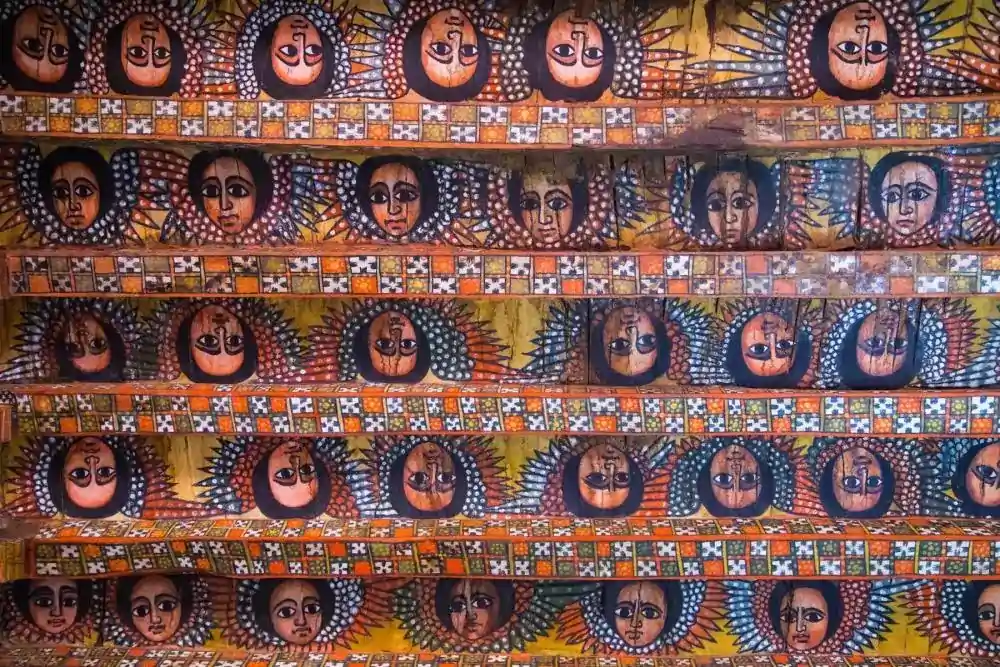
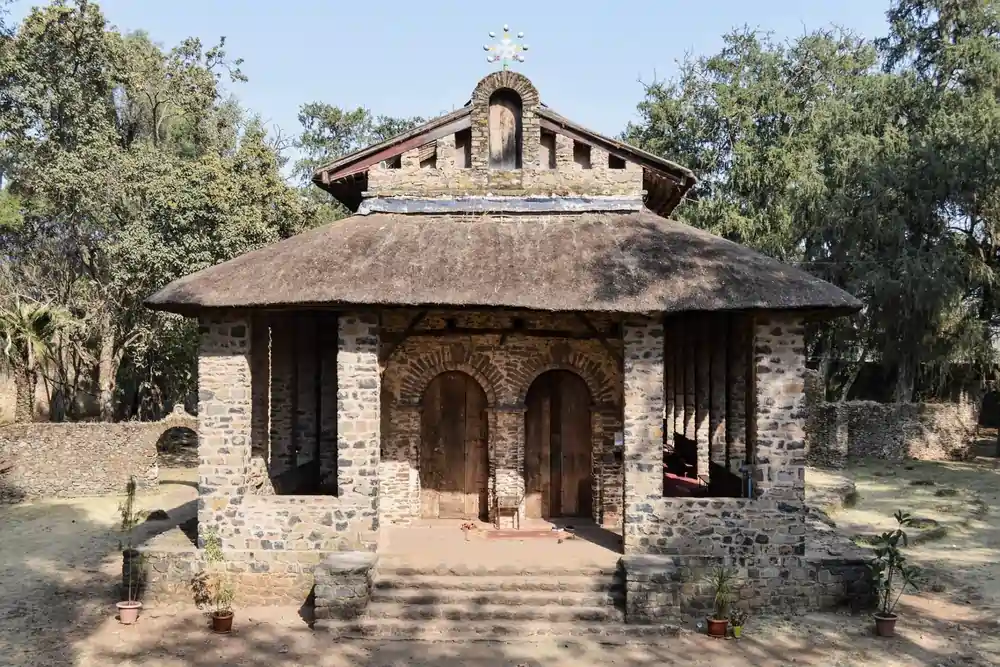
The Debre Birhan Selassie Church (Mount Light of the Trinity Church) in Gondar , Ethiopia, is not merely a place of worship; it is a living, breathing museum of Ethiopian Orthodox Tewahedo Church art and history. Part of the larger UNESCO World Heritage Site known as Fasil Ghebbi , Gondar Region, the church stands as one of the crown jewels of the Gondarine era. Renowned worldwide for its 17th century magnificent ceiling, which features the iconic, watchful faces of 135 cherubs, and wall paintings, a visit to this church is a profound journey into the spiritual and artistic heart of the Gondarine period.
History of Debre Birhan Selassie church & Emperor Iyasu I
The church was commissioned by Emperor Iyasu I (Adyam Seged Iyasu), the grandson of Emperor Fasilides, in the late 17th century. Its foundation is tied to one of Ethiopia’s most captivating religious stories —centered on the Ark of the Covenant (Tabot of Zion). Iyasu I built the church with the intention of bringing the Ark from Axum to Gondar. However, his request was denied by the Axumite clergy.
Undeterred, Iyasu I returned to Gondar and, following the guidance of a hermit, traveled to Debre Berhan Shewa, a site founded by Emperor Zär'a Ya'eqob. He obtained one of the two Tabots of the Holy Trinity from clergy. To cement the connection to Zär'a Ya'eqob’s Debre Berhan, the Emperor loaded soil from the original Debre Berhan—where a Pillar of Light (Amdä Berhan) had once descended—onto five hundred camels. He then personally carried the Tabot back to Gondar, used the sacred soil to level the ground around the new church, and named it Debre Birhan Selassie church.
In 1888 Gondar was sacked by Mahdist Dervishes of Sudan, Led by the Khalifa’s general, Zaki Tamal who ordered the torching of its churches. Legend says that when the Mahdist soldiers approached the church, a swarm of bees descended on the compound and kept the troops back. Legend states that Archangel Michael stood before the high wooden gates with a flaming sword drawn.
Architectural and Symbolic Design
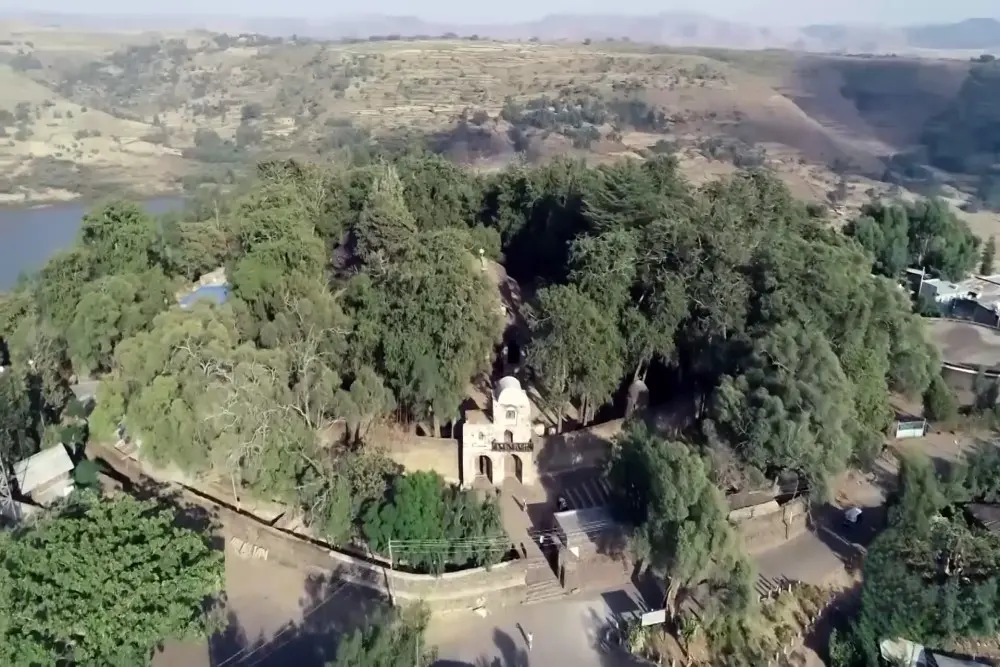
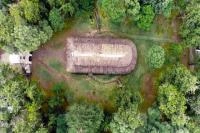
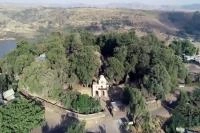
The architecture of Debre Berhan Selassie is deeply symbolic, with every component reflecting layers of religious tradition and Gondarine identity. The exterior gate of the church, built in a shape of a dome is designed to resemble a sleeping lion facing south, its window serving as the lion’s face and its tail extending behind it. This powerful image symbolizes kings who built churches, and the resurrected Christ. Surrounding the compound is a tall fence, intentionally constructed to symbolize the Walls of Jericho, while around the enclosure stand twelve egg-shaped domes, each representing one of the Twelve Apostles.
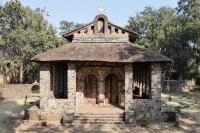
The church has two floors, each carrying significant biblical meaning. The upper level is modeled after Noah’s Ark, symbolizing salvation and divine protection, while the lower level reflects Solomon’s Tent, embodying ancient liturgical tradition. Both the upper and lower structures follow the traditional tripartite design of Ethiopian Orthodox churches, consisting of the Qine Mahlet (Hymn Section), the Kidist (Holy Place), and the Mekdes (Holy of Holies).
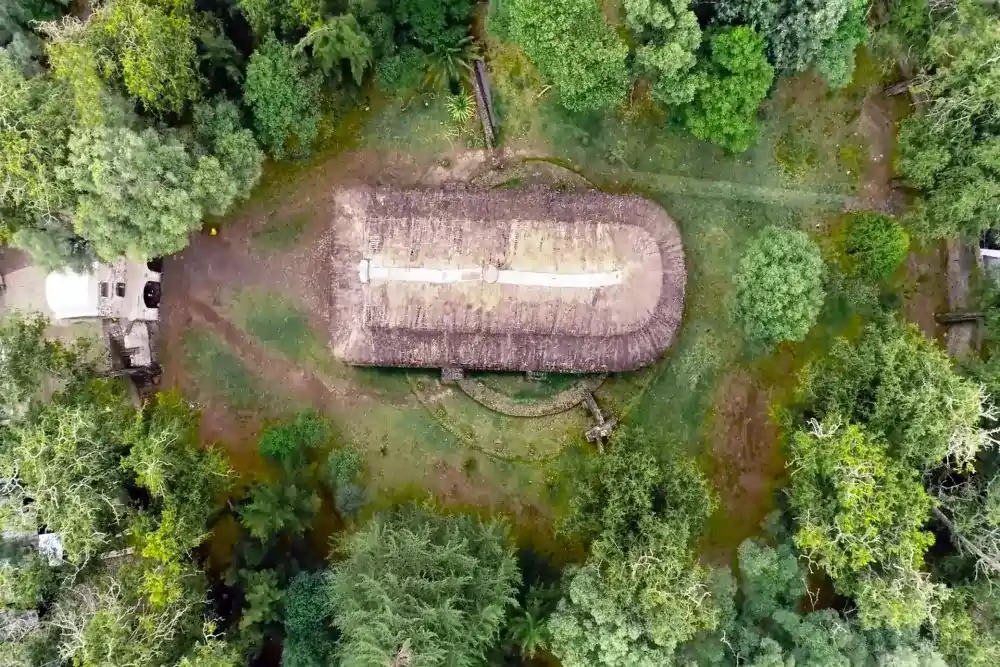
The roof also carries rich symbolism, featuring three domes each representing the crosses of Gondar, Axum , and Lalibela . These domes are topped with five and seven ostrich eggs, representing the Five Pillars of Mystery as well as the Seven Sacraments, Seven Heavens, and Seven Archangels. Originally, the roof was constructed from bamboo wood, clay tiles and traditional thatch, but it was later renovated by Emperor Haile Selassie, who replaced the clay with corrugated iron sheets covered in traditional thatch. This thatch layer continues to be renewed every 21 years, preserving the church’s historical appearance and symbolic meaning.
The Gondarine Painting Style
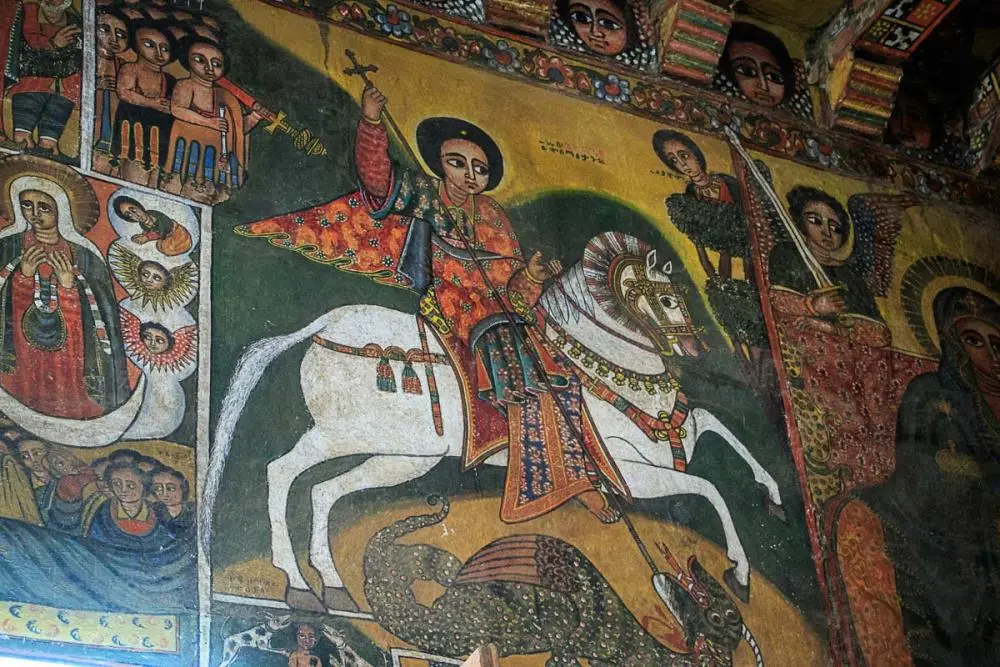
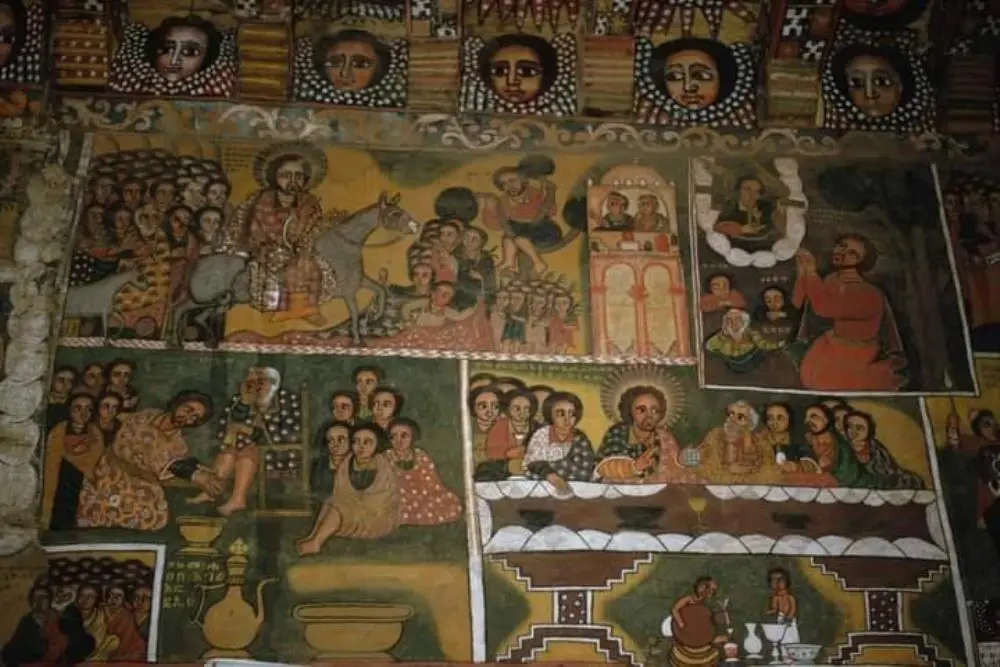
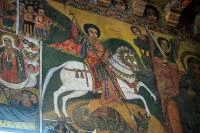
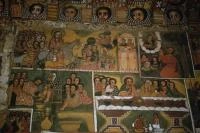
Debre Berhan Selassie stands as the finest representation of the second period of Gondarine painting style, which emerged after the 1660s and marked a vibrant shift from the earlier, more restrained style of the 1630s to 1660s. The earlier phase of Gondarine art was defined by wide eyebrows, purely religious themes, single-color backgrounds, and portrayals of all the Apostles as elderly men. In contrast, the second period—brilliantly exemplified in this church—introduced a richer and more expressive visual language. This later style incorporated both royal and religious themes, embraced a wider palette of decorative and bright colors, and included depictions of Ethiopian saints dating back to the Axumite era. The paintings are framed with intricate flower and cross motifs, and the vivid colors are applied over a single, unified background that covers the walls and ceilings in continuous narrative scenes.
Debre Berhan Selassie paintings were created by Abba Hailemeskel Woldu, a relative of Emperor Fasilides, who completed this monumental project in just four years. His technique was both innovative and distinctly Ethiopian: the paintings were made on a cotton (Shema Libs) and then put to the walls using a paste made from wheat (Sinde Muq). The pigments themselves were derived entirely from natural materials, including the Adey Abeba flower, animal blood, red earth, ash, charcoal, and the Kosheshle fruit, all of which contributed to the durability, texture, and luminous quality of the paintings that make Debre Berhan Selassie a masterpiece of Gondarine art.
A Sacred Story Told in Paint: The Walls of Debre Berhan Selassie
The interior walls of Debre Berhan Selassie form a breathtaking biblical tapestry, with each wall dedicated to a distinct spiritual theme. The East Wall focuses on the Holy Trinity and the Crucifixion, depicting the Holy Trinity holding the world, surrounded by the Four Living Creatures (Cherubim) and the 24 Heavenly Priests. This wall also illustrates key biblical scenes, including the Annunciation, Nativity, and the story of Gabriel the Archangel and the Three Holy Children. On the opposite side, the West Wall is devoted to the Virgin Mary, showcasing her miraculous appearance in the story of Debre Metmaq, positioned in such a way that visitors can see the unfragmented map of Ethiopia, including Djibouti, Eritrea, and Somalia.
The North Wall narrates the Life of the Virgin Mary (Negere Mariam), beginning with the prayers of Joachim and Anna, continuing through her presentation to the Temple (Baeta Le Mariam), and culminating in her Ascension. This wall also highlights the Kidane Mihret (Covenant of Mercy) and features numerous martyrs and iconic Ethiopian saints such as Abune Gebre Menfes Qidus and Abune Tekle Haymanot. The South Wall brings to life powerful scenes from the Gospel of Christ, including the Baptism, Temptation in the Wilderness, Transfiguration (Debre Tabor), Hosanna, Washing of the Feet, Holy Thursday ( the Last Supper ) Scourging, Resurrection, Ascension, and the Second Coming (Mits’at). It also depicts the martyrdom of Saints Peter and Paul, adding depth to its narrative sequence.
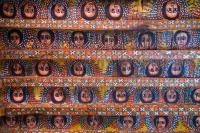
Above all, the church’s ceiling stands as the most iconic feature of Debre Berhan Selassie—a powerful visual reminder of God’s omnipresence. It is covered with the watchful faces of 135 cherubs, countless angels (Elf Alaf Melaekt) gazing in all four directions, symbolizing that God is present everywhere. These extraordinary cherubic faces have become the church’s defining hallmark, making Debre Berhan Selassie world-renowned and instantly recognizable. Together, the vividly painted walls and this unforgettable ceiling create one of the most spiritually immersive and visually captivating sacred spaces in all of Ethiopia.
Visiting Debre Berhan Selassie Church
Debre Berhan Selassie Church is situated just a short distance from Fasil castles or the Royal Enclosure, making it convenient to include on a one-day city tour of Gondar along with the Fasildes Bath & other major historical sites.
- • Access: The church is easily reachable by a brief taxi or tuk-tuk ride from the city center.
- • Entrance: In keeping with tradition, men enter through the North and West doors, while women use the South entrance. All visitors must remove their shoes before entering. It is also a long-standing custom—and a sign of respect—for women to cover their heads with a scarf, shawl, or traditional Netela. This practice is observed by both worshippers and visitors.
- • Experience: Inside, visitors can admire the magnificent ceiling and wall paintings. The church also displays sacred objects (Newaye Qiddisat) such as the drum (Kebero), sistrum (Tsinatsil), and prayer stick (Mequamiya), which are presented with explanations of their construction and spiritual meaning. A guide is recommended to understand the history ,symbolism of the paintings & sacred objects.
- • Visiting Hours: Open from 8:00 am – 12:30 pm, and again from 1:30 pm – 6:00 pm.
- • Photography: Photos are permitted, but flash is strictly not allowed inside the church.
A visit to Debre Berhan Selassie Church is an essential experience for anyone exploring Ethiopia’s rich historical and cultural treasures. This remarkable church is where art, history, and faith converge in a spectacular display of devotion. To make the most of your journey, book your Gondar tours with Worqamba Ethiopia Tours, including visits to Simien Mountains and Gorgora, and discover the full beauty and heritage of the region.
Related Tours
10 Days Simien Mountains Trekking
Trek to simien Mountain 1 day

Northern Ethiopia 12 Days Tour